The Gig Economy Is Becoming AI’s Sensor Network
DoorDash’s new Tasks app hints at a larger shift: gig workers are becoming a distributed real-world data layer for AI and robotics systems.
The strange thing about the next phase of AI labor is that it may not begin with people being replaced.
It may begin with them being recruited.
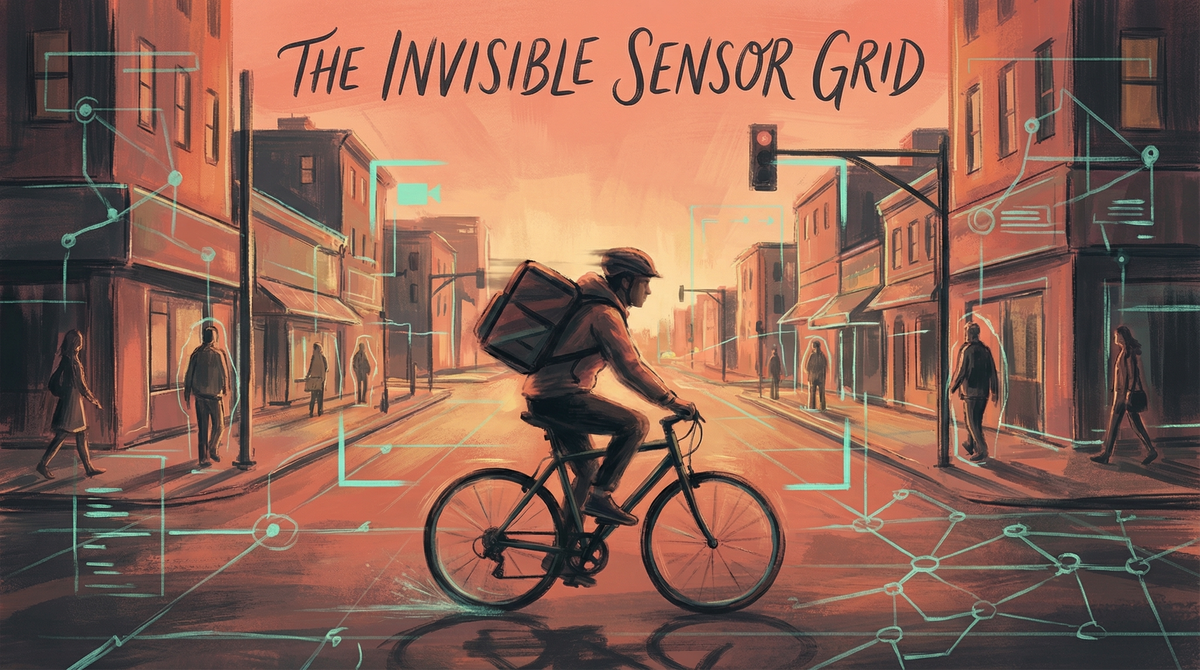
Not recruited as engineers. Not recruited as prompt whisperers. Recruited as bodies moving through the world with cameras, phones, context, and spare minutes between gigs.
That is what makes DoorDash’s new Tasks app such a revealing little story.
On the surface, it sounds almost harmless: another flexible earning feature in the endless gig-economy tradition of squeezing a few more dollars out of downtime. DoorDash says couriers can complete assignments like filming everyday activities, recording themselves speaking another language, taking photos of real places, or helping generate visual information that can improve AI and robotics systems.
But zoom out a little and the shape of the story changes.
What DoorDash is really exposing is a deeper shift in how machine intelligence gets built. AI systems do not just need compute and models. They need reality. They need messy, embodied, geographically distributed, constantly refreshed evidence about how the world actually looks, sounds, and behaves.
And platform companies already have something very convenient for that.
They have human networks.
Millions of them.
DoorDash said this week that it has more than 8 million Dashers who can reach almost anywhere in the United States. Read that sentence again, slowly. That is not just a labor force. It is a potential data-collection layer spread across streets, stores, apartment buildings, parking lots, kitchens, hotel entrances, and all the other annoying, irregular environments that autonomous systems still struggle to understand cleanly.
That is why this matters.
The gig economy is starting to look less like a side effect of app capitalism and more like part of AI’s sensor network.
The world is still expensive to digitize
One of the persistent fantasies in AI is that once the model is smart enough, the rest of the world will become legible on its own.
That is not how this works.
The physical world is ugly from a machine’s point of view. Lighting changes. Objects are partially obscured. Humans behave inconsistently. Buildings are weird. Entrances are badly marked. Streets are chaotic. Tasks that sound simple in English turn out to contain a thousand tiny ambiguities once you try to teach them to a system.
Which means reality still has to be collected, labeled, refreshed, and interpreted.
A lot of that work has historically been hidden inside data-labeling operations, outsourced moderation, clickwork platforms, or under-credited contractor ecosystems that keep modern AI from floating away into abstraction.
But this new phase is more embodied.
As multimodal systems, robotics systems, and real-world automation efforts expand, companies need first-person footage, edge-case visuals, location-specific context, and examples of ordinary human behavior in uncontrolled environments. They do not just need the internet. They need the world.
And the world, inconveniently, is still easiest to access through people who are already out in it.

Photo by MART PRODUCTION on Pexels.
DoorDash did not invent this. It made it legible.
What makes the DoorDash Tasks launch important is not that it created the category from scratch. It is that it made the category easier to see.
According to TechCrunch, the new app pays couriers to complete assignments meant to improve AI and robotic systems, including filming everyday tasks and recording speech. Bloomberg Law described one example task in notably concrete terms: capture footage of hands washing at least five dishes while wearing a body camera, holding each clean dish in frame before moving on.
That is a weird sentence to encounter in a logistics story.
It is also clarifying.
Because now the abstraction disappears. You can see the mechanism. Everyday human motion becomes training material. A routine physical act becomes data for machine evaluation. A worker’s time is no longer only valuable because it moves goods. It is valuable because it can convert lived reality into machine-readable input.
DoorDash is not alone here. Uber has also signaled interest in letting drivers complete small jobs such as uploading photos to help train AI systems. Some of DoorDash’s in-app tasks are less exotic but equally revealing: take photos of actual menu items, capture a hotel entrance so drivers can find the drop-off point more easily, help smooth the handoff around autonomous delivery programs.
All of that is part of the same trend.
The platform is not just coordinating labor. It is extracting environmental intelligence.
This is what happens when a workforce becomes infrastructure
The uncomfortable brilliance of the model is that platform companies do not need to build a new field network from scratch.
They already have one.
They already have workers distributed across geography, accustomed to app-mediated assignments, available in bursts, and conditioned to treat small slices of time as monetizable.
That is the real strategic advantage.
If you are a company trying to gather real-world training data, one of the hardest problems is not technical at all. It is logistical. How do you get eyes, hands, phones, and movement into the right places cheaply and repeatedly enough to make the data useful?
DoorDash’s answer appears to be: we already solved that part while building a delivery marketplace.
That is why the gig-economy framing is no longer enough on its own. These worker networks are becoming hybrid systems. They still move food, packages, and errands. But they can also capture storefronts, map drop-off realities, validate robot interactions, generate multimodal examples, and feed the endless appetite of machine learning systems for grounded data.
At that point, the workforce is not just labor. It is infrastructure.
And once a workforce becomes infrastructure, the questions get heavier.
Who owns the value created from that data? How is compensation determined? What kinds of consent are meaningful when micro-tasks are designed to feel casual? What happens when everyday life becomes a substrate for training systems that may later reduce the bargaining power of the same workers helping build them?
Those are not fringe concerns. They are the story.
The labor bargain here is stranger than it looks
There is an easy way to spin this positively, and to be fair, part of it is true.
More flexible ways to earn can help people. Some workers will absolutely want the option to pick up small tasks between deliveries. Some tasks will be benign. Some may improve navigation, reduce friction, or create more accurate representations of real conditions on the ground.
Fine.
But the deeper labor bargain is still odd.
A worker is being paid a relatively small amount to capture pieces of reality that may help improve systems with much larger downstream commercial value. The worker gets cash now. The platform and its partners get reusable data, operational insight, and potential model improvement later.
That asymmetry is not new in digital labor. But here it becomes unusually vivid because the work feels so tangible.
Wash the dishes. Film the room. Photograph the entrance. Close the self-driving car door. Record the phrase. Show the environment.
Each action is tiny. The aggregate effect is not.
The aggregate effect is that human beings become distributed instrumentation for machine systems.
That does not automatically make the model exploitative in every case. But it does make the old language of “side hustle flexibility” feel a little too cute for what is actually happening.

Photo by Norma Mortenson on Pexels.
Before robots scale, humans may be asked to train the world for them
There is a broader pattern here that I suspect we will see more often.
Before automation can scale cleanly in the physical world, companies may increasingly rely on workers to help prepare the environment for it.
Not just by labeling data on a laptop, but by documenting streets, objects, rooms, speech, gestures, storefronts, edge cases, and machine awkwardness in situ.
That is especially true for robotics and physical AI, where real-world variance is the enemy and synthetic data still needs grounding.
So the labor sequence may look less like:
- robots arrive
- humans disappear
And more like:
- humans gather and validate the world for machines
- systems improve through that input
- workflows reorganize around the improved systems
- then the displacement conversation gets sharper
That is a more honest account of how technological transitions often work. People are not merely replaced by the system. They are often enrolled in building it first.
There is something almost darkly elegant about that.
The sensor layer of AI will not announce itself politely
This is also one of those shifts that can spread without much public language around it.
No company needs to say, “we are turning a precarious workforce into a distributed sensing apparatus for machine intelligence.” That would be a terrible press release.
They can just talk about flexible earnings, better ground truth, improved logistics, richer local insights, more accurate AI, more businesses understanding what is happening on the ground.
And to be clear, some of that language would not even be false.
But it would still miss the more interesting frame.
The sensor layer of AI is not going to be built only out of cameras mounted on poles, satellites in orbit, or robots wandering warehouses. Part of it will be built out of people carrying phones through ordinary life, nudged by platforms to convert experience into structured machine input. That will not define every labor platform or every AI workflow, but it is clearly becoming one important pattern.
That is a bigger cultural shift than one app launch.
It suggests that the boundary between labor platform and data platform is eroding fast.
This is the kind of AI story that actually tells you where the market is going
A lot of AI coverage still gets trapped in the same old loops: benchmark jumps, funding rounds, chatbot upgrades, the latest grand claims from companies trying to sound inevitable.
Those stories matter. But the market often reveals itself more clearly in smaller operational moves.
A delivery company launches a side app and suddenly you can see a whole future labor architecture peeking through it.
Not because DoorDash solved physical AI. Not because one Tasks app changes everything overnight. But because it shows what companies have started to understand: if AI needs grounded data from the real world, the cheapest scalable collection layer may already exist inside the labor platforms built over the last decade.
That is the kind of insight worth paying attention to.
The next phase of AI will not just be about smarter models. It will be about who can continuously feed those models with reality.
And increasingly, that reality may be collected one gig worker, one phone camera, one awkward little task at a time.