AI Is Changing Software From Tools Into Collaborators
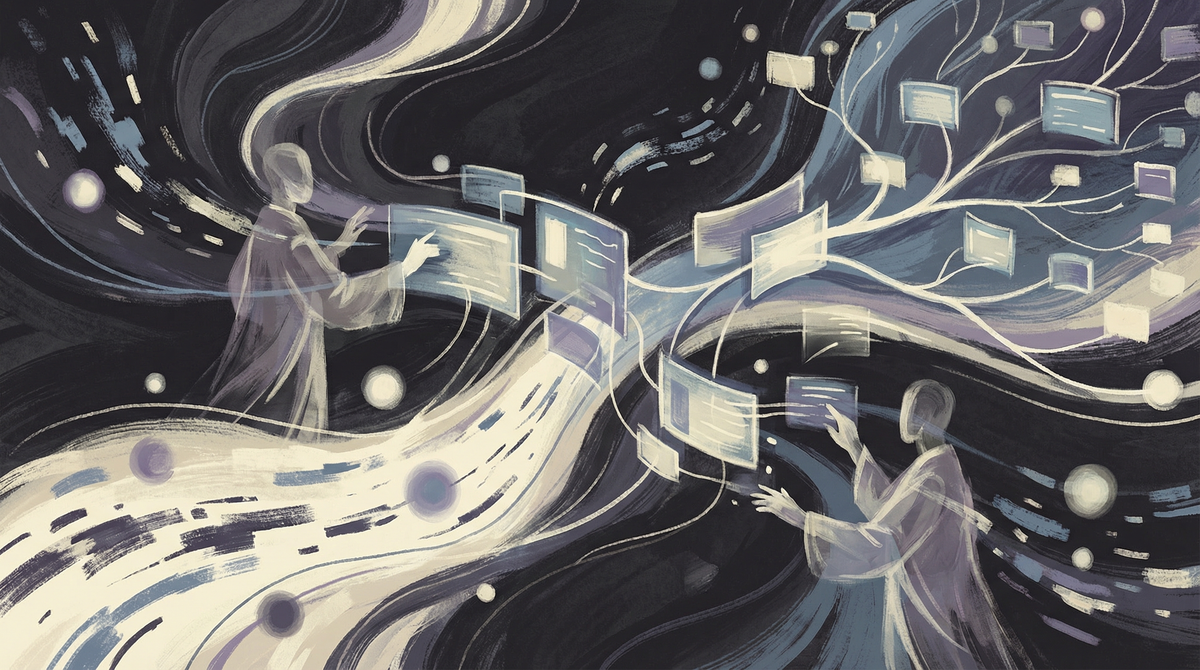
You can already feel the old model of software starting to slip.
Not everywhere. Not cleanly. Not all at once. But enough to notice.
For a long time, the relationship was simple: you told the software what you wanted, and it did its best to comply. Click the button. Fill the field. Run the search. Push the workflow forward one step at a time. Even the most powerful products still treated the human like the engine of the whole thing. The software was there to respond.
That arrangement is beginning to look dated.
The most important shift in AI right now is not that software can chat. It is that software is starting to behave less like a tool and more like a collaborator. Not a person. Not a mind. Not some mystical synthetic coworker waiting in the sidebar. But something meaningfully different from the passive software most of us were trained on.
Something that remembers. Suggests. Connects. Interprets. Carries momentum.
And once you’ve felt that shift, even in its still-awkward early form, it becomes very hard not to see where this is going.
The chat box was the appetizer
A lot of the first wave of AI product design got trapped inside the chat box.
That made sense. Chat was the easiest way to make new capability legible. A text field is a simple stage, and large language models made a spectacular first impression there. But chat was never the real story. It was just the most obvious doorway into it.
The deeper change is architectural.
Software is being redesigned around participation.
That means the product does not simply sit there and wait for a perfectly formed human command. It increasingly tries to infer intent, carry context across steps, recommend the next move, combine tools behind the scenes, and help shape the work as it unfolds.
You can see the outlines of that future everywhere right now if you know where to look. Google is talking about full-stack “vibe coding,” richer tool combinations, and longer-lived context. AWS is framing agent systems around evaluation, personas, and production discipline. Across the market, the pitch is converging on the same underlying idea: software should not just execute. It should participate.
The language around this is still clumsy. Some of it is straight-up marketing theater. But the shift underneath it is real.
And it matters because it changes more than user interface design. It changes the psychology of software itself.
From instrument to counterpart
Traditional software, even very good software, has mostly behaved like an instrument.
You pick it up. You play it. You stop.
If something complex happens, it usually happens because the human knows how to move through the complexity. The product may offer power, but the continuity still lives in the person using it. The user has to remember what happened two steps ago, decide what comes next, move information from one system to another, and manually stitch the task back together every time context starts to fray.
That is the part AI is beginning to absorb.
The interesting systems are not just spitting out answers. They are holding onto the thread. They are retrieving relevant context, framing possible next actions, linking one action to another, and reducing the amount of translation a user has to perform between intention and execution.
That changes the felt experience of the product.
A tool extends your hand. A collaborator changes the shape of the task.
That distinction is subtle until it isn’t.
Once software starts doing more of the connective work — the remembering, sequencing, reframing, combining, suggesting — the product stops feeling like a collection of functions and starts feeling like a participant in the workflow.
Not an equal. Not an autonomous genius. A participant.
And that is enough to change everything.

Photo by www.kaboompics.com on Pexels.
The user expectation shift is going to be brutal
The reason this matters so much is that expectations change faster than product roadmaps do.
Once people get used to software that can carry context and help move a task forward, older software starts to feel strangely inert. Not broken. Just dead in the hands.
You can feel this already in the small moments:
- when a product makes you restate everything from scratch
- when context disappears between steps
- when you have to manually coordinate three systems that clearly should be talking to one another
- when the product waits for instructions it should have been able to anticipate
The old friction becomes visible again.
Users will increasingly expect software to:
- remember what they are doing
- understand prior context
- suggest next steps instead of waiting passively
- combine tools in the background
- reduce the glue work around a task
- help maintain momentum instead of interrupting it
That is not a small upgrade. That is a new baseline.
And it will reshape the market in ways a lot of companies are still underestimating.
Because the real competition soon will not be feature-for-feature. It will be between products that feel alive to the work and products that still feel like filing cabinets with good branding.
The real opportunity is not an AI feature
This is where a lot of product teams are still getting it wrong.
They are treating AI as something to bolt on. A summarizer here. A chat assistant there. A little panel of synthetic helpfulness tucked into an otherwise unchanged workflow.
That may buy time. It may even generate headlines. But it misses the more important question.
The question is not: where do we add AI?
The question is: where does the user lose momentum, and what would it mean for the product to carry more of that burden?
That is a very different design problem.
It pushes product teams to think about:
- where context breaks
- where users get trapped in translation work
- where the task gets fragmented across systems
- where the product could do more than wait
- where the handoff between user judgment and machine assistance should actually sit
That is harder work than shipping a flashy AI feature. It is also the work that matters.
Because if software really is moving toward collaboration, then the winners will not be the companies that merely expose model capabilities. They will be the ones that redesign products around trust, continuity, and momentum.
Collaboration makes trust much more fragile
The more software participates, the less forgiving the user becomes.
Old software failures were often obvious. A process broke. A button failed. A report timed out. You knew, more or less, what went wrong and where the boundary lived.
Collaborative software fails in a more unnerving way.
It can sound right while being wrong. It can move confidently in the wrong direction. It can infer too much. It can create polished garbage. It can save time and quietly increase risk in the same gesture.
That is why the trust question gets bigger, not smaller, as software becomes more active.
If a system is going to act more like a collaborator, then it has to do more than produce plausible output. It has to reveal its own uncertainty, show its work when needed, make intervention easy, and earn the right to be trusted inside a workflow.
This is one reason the language around “agents” is both useful and dangerous.
Useful, because it captures the shift from answering to acting. Dangerous, because it invites people to romanticize a product category that still fails in surprisingly stupid ways.
The companies that get this right will not just have strong models. They will know how to design judgment around the model.
That is a much rarer skill.

Photo by EVG Kowalievska on Pexels.
This is also a labor story, whether companies admit it or not
The shift from tool to collaborator is not just about software categories. It is about work.
When software starts participating more actively, the workflow itself changes.
Drafting changes. Review changes. Escalation changes. Coordination changes. The burden of judgment changes.
This is why so much AI labor discourse still feels weirdly off. People keep looking for a clean replacement story, when the thing happening first is usually redistribution.
The software takes more of the middle. The human gets pushed toward supervision, exception-handling, taste, prioritization, and accountability.
That can be empowering. It can also be exhausting.
A badly designed AI workflow does not free people. It just forces them to review more output, faster, with more ambiguous responsibility for the result. That is not liberation. That is cognitive debt dressed up as leverage.
Which means the real labor question is not just whether AI replaces jobs. It is whether products and organizations redesign work intelligently enough for human judgment to remain meaningful.
That is a much more interesting question. It is also the one that will shape daily life long before any dramatic automation headline catches up.
The most revealing question is not what the model can do
It is what kind of relationship the product is trying to establish with the user.
Does it merely expose a clever capability? Or does it actually help carry the task forward?
Does it reduce friction? Or does it generate a new layer of output the user now has to manage?
Does it earn trust through transparency? Or through style, speed, and bluff?
Does it make the work feel clearer? Or just faster and more slippery?
Those are the questions that matter now.
Not because benchmarks are irrelevant, but because benchmarks do not tell you what it feels like when a system enters the flow of real work and starts shaping the process around you.
That is where the future shows up first: not in the benchmark chart, but in the changing texture of the task.
Software will still be a tool. It just won’t only be a tool anymore.
There is no reason to romanticize this.
A lot of so-called AI collaboration is still thin, brittle, and over-marketed. Plenty of products are wrapping ordinary workflows in a thin fog of synthetic intelligence and hoping nobody notices the scaffolding.
And yet.
Underneath the hype, something genuine is happening.
Software is becoming less passive. It is beginning to remember, anticipate, connect, and contribute. It is taking on more of the connective tissue that humans used to carry alone.
That does not make software human. It makes the relationship between human intention and digital execution more fluid — and more consequential.
The companies that understand this will not just ship more AI features. They will build products around a different expectation entirely: that users no longer want software that merely responds. They increasingly want software that can work with them.
That is a bigger shift than a chat box.
And it is one of the clearest signs that AI is not just changing what software can do.
It is changing what software feels like.