AI Infrastructure Is Becoming a Public-Utility Fight
The AI buildout has entered a less glamorous phase.
For a while, the story could be told in the language Silicon Valley likes best: more chips, more campuses, more capital, more inevitability. A boom in clean lines and giant numbers. The future, supposedly, was just a matter of scaling the stack.
But large infrastructure booms eventually run into other people.
That is what the data-center fight is becoming now. Not just a question of whether companies can build enough compute, but whether communities, utilities, regulators, and ratepayers are willing to reorganize local life around it.
Google’s new demand-response agreements, which make up to 1 gigawatt of its data-center load available for curtailment during periods of grid stress, are one signal. The Sanders–Ocasio-Cortez proposal for a federal moratorium on new AI data centers is another, much blunter one. Add local moratorium pushes, utility-cost anxiety, water fights, and the rising sense that a handful of companies are trying to rewrite land-use and energy politics at industrial speed, and the shape of the next conflict comes into focus.
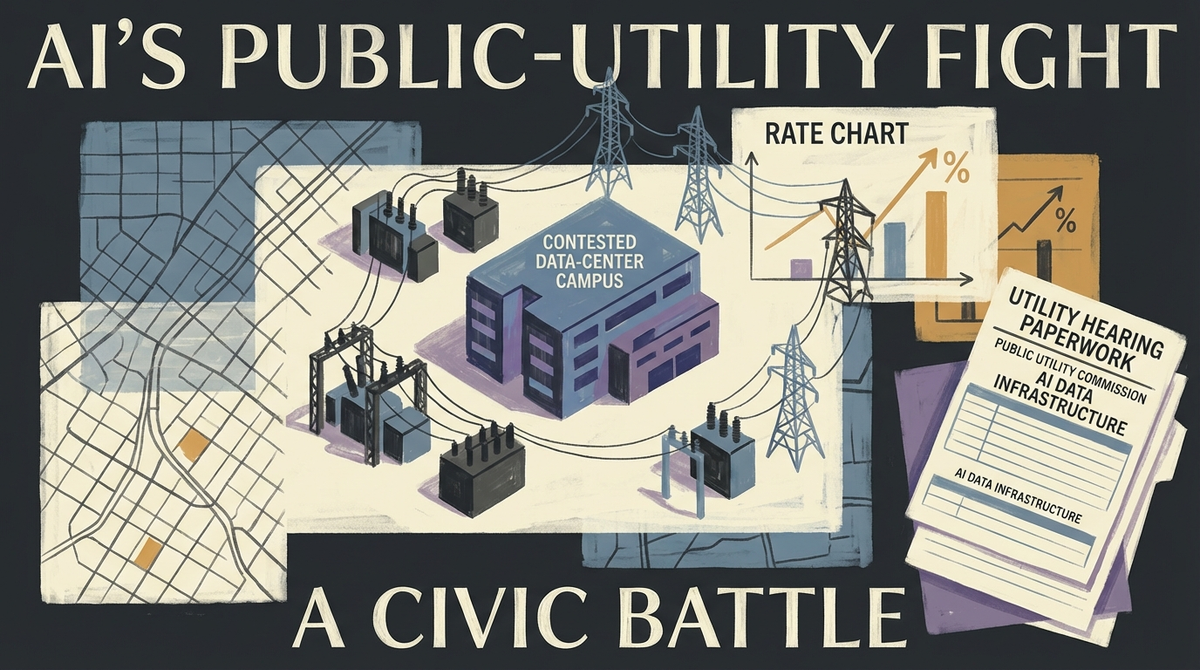
AI infrastructure is no longer just an engineering story. It is becoming a public-utility fight.
The old frame was growth. The new frame is burden.
The easiest way to misunderstand this moment is to think the problem is merely that data centers use a lot of electricity.
They do. But that sentence is too small for what is happening.
The real issue is that AI infrastructure arrives as concentrated private demand with public consequences attached. It lands in transmission plans, interconnection queues, local water systems, gas-generation debates, tax packages, zoning fights, and household electric bills. The benefits are narrated globally. The burdens are often carried locally.
That is why the political mood is changing.
Once a project starts looking less like “innovation investment” and more like “your town is being asked to absorb someone else’s compute ambition,” the argument gets rougher. People want to know who gets priority on the grid, who pays for upgrades if forecasts are wrong, whether special tariff treatment quietly socializes risk, and why urgency always seems to belong to the hyperscaler rather than the public.
Those are not anti-technology questions. They are the adult questions.
Big Tech is learning it cannot just buy power. It has to negotiate legitimacy.
Google’s demand-response expansion matters because it shows the industry adapting to that reality.
Reuters reported that the company now has agreements with five U.S. utilities — Entergy Arkansas, Minnesota Power, DTE Energy, Indiana Michigan Power, and the Tennessee Valley Authority — making up to 1 gigawatt of load available for curtailment during high-stress periods. That is not a symbolic sustainability flourish. It is an operational acknowledgment that future data-center growth may depend on behaving more like a flexible grid participant.
That is smart. It is also revealing.
If the old infrastructure model was: secure power, sign contracts, build fast. The new one looks more like: secure power, offer flexibility, reassure regulators, calm communities, defend your cost structure, and try not to become the villain in somebody’s utility hearing.
In other words, the AI industry is discovering that legitimacy has operating requirements.
That is a much harder game than product marketing.
The grid is becoming the place where AI gets forced to answer political questions
For all the talk about model safety, bias, and labor displacement, one of the most concrete forms of AI accountability may arrive through infrastructure politics instead.
Can this project connect without pushing costs onto ordinary customers? Can this utility justify the upgrade plan? Can this community absorb the land, water, traffic, or emissions burden? Can regulators verify that the economics make sense if projected demand changes? Can the public see the deal clearly enough to object before it is a fait accompli?
That is what makes the “public-utility fight” frame stronger than the standard “power bottleneck” frame.
A bottleneck sounds technical. A utility fight is about who gets heard, who gets protected, and whose needs are treated as negotiable.
The AI industry has spent years speaking as if compute demand were destiny. Utility politics is where destiny gets cross-examined.
The moratorium proposal is clumsy. It is also a signal.
The Sanders–Ocasio-Cortez bill to pause new AI data-center construction until stronger national safeguards are in place is the kind of proposal the industry will dismiss as extreme, anti-growth, or unserious.
Some of that criticism is fair. A national moratorium is a sledgehammer. It is unlikely to become law. It mixes several anxieties together — labor, safety, environment, democratic oversight — in a way that is more politically expressive than operationally precise.
But that would be the lazy read.
The more interesting read is that this kind of proposal appears when the public feels the system is moving too quickly for ordinary oversight to matter. It is a symptom of legitimacy strain.
And legitimacy strain matters even when the bill itself goes nowhere.
Because once lawmakers start discovering that “AI data centers” can function as a popular shorthand for higher utility bills, local disruption, and billionaire power, the industry loses the luxury of presenting infrastructure growth as a neutral national good. It has to argue, in public, for why its expansion deserves priority over competing uses of land, energy, water, and political patience.
That is new.
The real risk is not only backlash. It is bad planning under pressure.
There is a version of this story where the only lesson is that communities are pushing back.
That is incomplete.
The deeper risk is that institutions under political and economic pressure make rushed, opaque, or overly generous decisions because they are afraid of missing the boom. Utilities may overbuild. Regulators may under-scrutinize. Local officials may sign onto benefits that look impressive on a podium and much murkier inside a 20-year cost structure.
Politico’s reporting on Ohio captures the cleaner version of that fear. AEP’s large-load tariff now pushes data centers into longer commitments, minimum-demand charges, and load-study fees precisely because utilities and regulators are trying to separate serious projects from speculative “paper demand.” The Ohio Manufacturers’ Association put the public-cost issue bluntly: customers can end up paying for a future that never arrives if speculative forecasts are allowed to drive real infrastructure decisions.
Infrastructure bubbles are dangerous partly because they train everyone involved to confuse speed with competence.
The AI buildout has some of that smell already.
If projected demand softens, if technology shifts alter compute footprints, if promised jobs underdeliver, or if local costs prove larger than advertised, the cleanup will not happen on an earnings call. It will happen in rate cases, budget fights, and public anger.
That is what makes this more than a temporary permitting headache. It is a governance test.
The next phase of AI competition may be fought in hearings, not launch events
The industry still prefers to narrate itself through technical milestones. New model. New chip. New campus. New capital commitment.
But the harder story is becoming institutional.
Who can build without triggering revolt? Who can make their load flexible enough to be politically tolerable? Who can persuade regulators that they are not quietly exporting risk to everybody else? Who can move fast without looking predatory?
That is not as cinematic as a frontier-model demo. It is more consequential.
Because once AI becomes a public-utility fight, the relevant skill is no longer just technical superiority. It is the ability to operate inside democratic systems that do not automatically share Silicon Valley’s timetable or its appetite for concentrated private power.
And frankly, that is healthy.
If AI is going to reorganize physical systems at this scale, it should have to survive more than investor enthusiasm. It should have to survive public scrutiny.
That is the fight coming into view now. Not whether AI will keep expanding, but under what terms, at whose expense, and with how much consent.
That is what utility politics is for.